
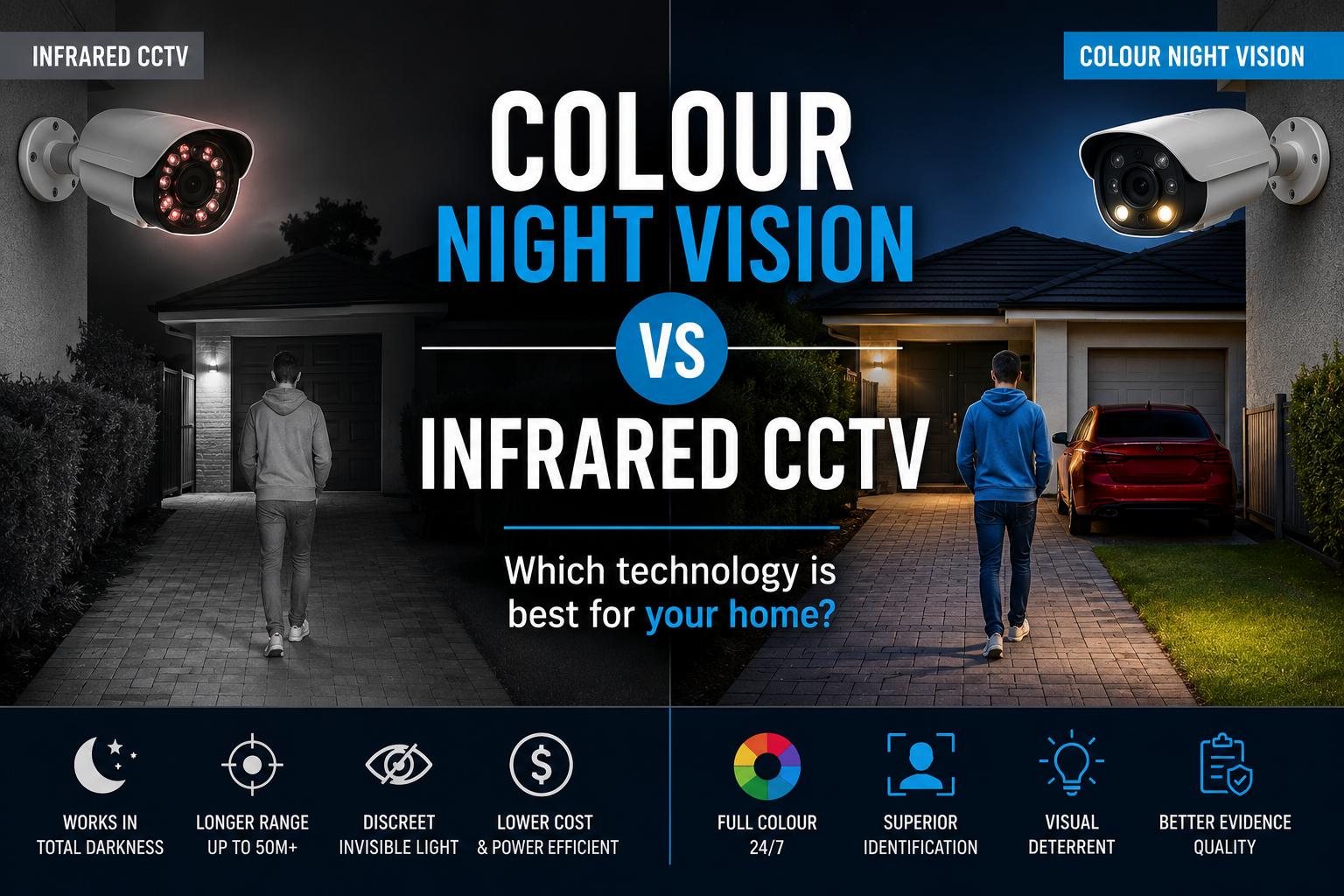
When the sun goes down, the quality of your security footage becomes your property’s most critical asset.
In Perth, where coastal properties, large suburban blocks, and dark side-access paths create unique surveillance challenges, choosing the right protection during the night is a strategic decision.
Two technologies currently lead the CCTV system market:
- Full-Colour Night Vision
- Infrared (IR) Night Vision
While both systems aim to solve the problem of darkness, they do so using completely different methods.
One relies on advanced sensors to “find” light where the human eye cannot, while the other uses invisible light to paint a picture in total blackness. The choice you make impacts everything from the legal weight of your evidence to how many false alerts you receive on your phone at 3 AM.
Whether you’re securing a high-density apartment in the CBD or a sprawling estate in the Perth Hills, understanding these night-vision fundamentals ensures you aren’t left in the dark when security matters most.
Colour Night Vision
Colour Night Vision delivers full-colour footage after dark by using enhanced low-light sensors and intelligent image processing. This approach helps homeowners capture more identifiable detail, especially around driveways, front entries, and street-facing zones where ambient lighting exists.
Pros
- Captures clothing, vehicle, and object colours for easier identification
- Improves evidence quality for police reports and insurance claims
- Produces more natural footage that feels closer to daytime recording
- Performs strongly near porch lights, streetlights, and lit alfresco areas
- Helps reduce confusion between similar objects during investigations
- Enhances facial and vehicle recognition outcomes in supported systems
Cons
- Needs some surrounding light to maintain consistent colour clarity
- Performance may drop sharply in pitch-black areas without lighting
- Strong backlighting can create glare and reduce usable detail
- Higher-end sensor requirements can increase the upfront system cost
- May struggle in fast motion scenarios if the lighting remains low
Infrared (IR) Night Vision
Infrared (IR) Night Vision uses invisible infrared illumination to light up dark areas, producing black-and-white images even when outdoor lighting is minimal. This option remains popular for Perth properties with side access, rear yards, and low-light zones where visibility is otherwise limited.
Pros
- Works effectively in complete darkness without external lighting
- Provides reliable coverage for large yards and narrow access paths
- Strong contrast improves the detection of movement and silhouettes
- Delivers consistent results regardless of streetlight availability
- Suitable for night monitoring without visible brightness or disturbance
- Often performs well across longer distances in open outdoor areas
Cons
- Records in black-and-white, reducing identification detail
- Fine features like clothing colour and vehicle paintwork become unclear
- Reflective surfaces can cause washout and reduce sharpness
- Insects and rain can create visual noise near lens-mounted IR emitters
- Strong IR reflection from walls may reduce image balance in tight spaces
Quick Comparison Table
| Feature / Factor | Colour Night Vision | Infrared (IR) Night Vision |
| Image output style | Full-colour footage in low-light conditions | Black-and-white footage using invisible illumination |
| Best performance environment | Areas with nearby lighting or ambient glow | Areas with minimal or zero lighting |
| Identification strength | Stronger visual detail for recognition | Stronger silhouette clarity, weaker detail identification |
| Motion performance | Can blur if the lighting remains too low | Often stays consistent in darker zones |
| Usefulness for evidence | Higher detail for reports and disputes | Reliable visibility, reduced descriptive detail |
| Range in darkness | Limited without supporting light | Strong coverage even in total darkness |
| Impact of reflective surfaces | Glare is possible in bright contrast zones | Washout possible near light-coloured walls |
| Ideal placement zones | Front entry, driveway, garage frontage | Side paths, backyards, unlit boundaries |
| Common drawback | Depends on lighting conditions | Limited colour-based recognition |
Which System Performs Best in Perth Conditions?
| Factor | Colour Footage | Infrared Footage |
| Low-light efficiency | Performs best with ambient lighting support | Performs strongly even in total darkness |
| Upfront cost | Often higher due to sensor requirements | Often more budget-friendly across standard ranges |
| Ongoing running cost | May benefit from existing lighting | Runs independently without extra lighting needs |
| Durability in harsh weather | Strong, though glare and moisture can affect clarity | Reliable, though rain and insects may reduce sharpness |
| Lifespan expectations | Long-term performance depends on sensor quality | Long-term performance depends on IR emitter quality |
| Aesthetic appearance at night | Produces natural-looking footage | Produces high-contrast monochrome images |
| Environmental impact | May encourage the use of external lighting use | Reduces the need for extra lighting in dark zones |
| Identification accuracy | Stronger for facial detail, vehicles, and clothing | Stronger for movement detection, weaker for colour recognition |
| Motion handling | May blur if the lighting remains limited | Often maintains clearer outlines during movement |
| Best suited installation zones | Driveways, entrances, street-facing areas | Side access, backyards, rural blocks, boundary lines |
| Ideal homeowner priority | Evidence clarity and recognition | Reliable coverage and consistent detection |
Efficiency and Low-Light Performance
Colour footage works like a smart upgrade to human eyesight, pulling colour detail from nearby light sources and processing footage to keep images clear.
Homes with streetlights, sensor lighting, patio downlights, or illuminated garages usually see excellent results, since even mild brightness supports sharper night footage. This performs especially well when identifying fine details matter more than simply detecting movement. Clothing colours, vehicle paintwork, fence stains, or distinguishing features around a front yard become far easier to interpret.
Infrared footage focuses on consistent visibility, even when lighting drops to near-zero. Invisible illumination activates automatically, allowing cameras to “see” through darkness without relying on outdoor lighting. Properties with long side access paths, large backyards, or unlit boundary areas often benefit from this approach, since coverage stays reliable regardless of surrounding brightness.
Cost and Value for Money
Pricing depends on camera quality, sensor grade, recording resolution, and system design, though general trends still apply.
Colour footage usually costs more upfront because colour clarity after dark requires stronger sensors and advanced processing. Higher-end models deliver impressive results, yet budget units may struggle if lighting remains inconsistent, which can reduce value if installed in the wrong area.
Infrared footage often sits in a more accessible price range, particularly across entry-level and mid-range systems. Strong results in total darkness can make this style cost-effective for homeowners wanting reliable coverage without upgrading outdoor lighting.
For a realistic budget range, use this CCTV systems cost guide for Perth homeowners to understand what drives pricing beyond camera count alone.
Durability and Lifespan
Colour footage can deliver outstanding footage for years, though image clarity may be impacted by glare, moisture on lenses, or rapid lighting changes from passing cars. Higher-grade housings and proper installation angles reduce these issues, improving long-term reliability.
Infrared footage tends to handle total darkness consistently, though heavy rain, fog, and insect activity can create “white specks” or haze when infrared illumination reflects off airborne particles.
This doesn’t mean failure, but visibility can drop slightly during certain weather events.
Lifespan also depends on build quality, lens protection, heat tolerance, and correct placement. A well-installed system in a sheltered position will last far longer than a unit exposed to full sun and constant rainfall.
Aesthetics and Environmental Impact
Colour footage creates a more natural viewing experience, showing gardens, fences, vehicles, and visitors in realistic colour. That often feels more reassuring for families checking cameras at night, since footage resembles daytime recording.
This may encourage you to add outdoor lighting for the best performance. Extra lighting can improve security perception, though it may increase energy use if poorly managed.
Infrared footage produces high-contrast black-and-white footage, which can look less “premium” yet remains highly functional. Since built-in illumination handles visibility, fewer external lights may be required, which can reduce unnecessary glare and light pollution.
Identification and Evidence Quality
Colour footage generally delivers stronger evidence value because colour can identify clothing, car type, paint colour, and distinguishing features. Recognition improves significantly when capturing faces near entry points, driveways, or front gates.
Infrared footage excels at confirming presence and tracking movement, yet colour-based detail disappears. That can make identification harder if multiple suspects wear similar clothing or if a vehicle needs a description beyond shape.
If your priority is “Who was that?” rather than “Was someone there?”, colour-based recording usually provides more usable proof.
Motion Handling and Night Activity
Colour footage may show motion blur if the lighting remains weak, especially when a person moves quickly across a dim driveway. Higher-quality sensors reduce this issue, though low-light conditions still challenge colour footage more than monochrome capture.
Infrared footage often maintains sharper outlines during motion because infrared illumination boosts visibility instantly. For properties where movement detection matters more than fine detail, this style can deliver more consistent results.
Range and Coverage Distance
Colour footage performs best at closer ranges where ambient light supports colour clarity. Front doors, garages, carports, and patios often sit within ideal coverage zones, making this style highly effective for suburban Perth homes.
Infrared footage tends to handle longer distances more reliably, particularly across backyards, acreage blocks, or boundary lines where lighting remains absent. Range performance varies by model, though infrared illumination usually offers stronger distance visibility in complete darkness.
Installation Requirements and Placement Flexibility
Colour footage benefits from thoughtful lighting placement. Downlights, motion-sensor lighting, or soft garden lighting can dramatically improve results without turning a home into a spotlighted fortress. Positioning also matters, since strong backlighting can cause glare or reduce facial clarity.
Infrared footage provides more flexibility because external lighting isn’t required. Side access areas, narrow laneways, and rear fences can stay fully covered even if no lights exist nearby. Placement still needs care, since walls or reflective surfaces may cause infrared washout.
If you’re weighing reliability versus convenience, this breakdown of wired vs wireless security cameras for Perth homes helps clarify trade-offs that affect night footage.
Privacy Considerations and Neighbour Impact
Colour footage may encourage brighter outdoor lighting, which can disturb nearby homes if positioned poorly. Adjusted angles, sensor lighting, and controlled brightness prevent unnecessary glare.
Infrared footage avoids visible light, making surveillance less intrusive at night. That can reduce neighbour complaints while still maintaining coverage, especially in tight suburban blocks.
Before finalising camera angles, review where CCTV cameras aren’t allowed and placement guidelines to avoid neighbour disputes and compliance issues.
Best Use Scenarios for Perth Properties
For a driveway, front door, garage entry, or street-facing frontage, colour footage usually delivers stronger recognition results because ambient light supports colour detail.
For side access, backyard zones, rural blocks, or properties with minimal outdoor lighting, infrared footage often provides more reliable coverage without extra infrastructure.
Matching Night Vision to Your Property Layout
Driveways and Street-Facing Frontage (Colour Night Vision)
Front yards in Perth often benefit from streetlights, passing headlights, porch lighting, and neighbouring illumination, which makes Colour Night Vision a strong fit for driveway coverage. Clear colour detail improves the chance of identifying vehicle paintwork, number plates at close range, clothing colours, and distinguishing features that matter during incidents.
Side Access Paths and Narrow Walkways (Infrared)
Many Perth properties include long, shaded side passages that stay dark even during evening hours. Infrared performs reliably in these areas because built-in illumination doesn’t depend on exterior lighting, making movement detection consistent across the entire corridor.
Backyards, Sheds, and Rear Boundaries (Infrared)
Rear fences, detached garages, workshops, and pool equipment areas suit this alternative well because darkness won’t reduce clarity in the same way it can with colour-based recording. Properties with dogs, garden gates, or rear laneway access benefit from stable coverage that continues through late-night hours.
Front Doorways and Porch Entries (Colour Night Vision)
Entry points usually have at least some ambient lighting from downlights or sensor fixtures, making this option ideal for capturing visitors clearly. Facial recognition, package drop-offs, and door-to-door activity become easier to confirm when footage includes realistic colour detail.
Garages, Carports, and Internal Courtyards (Colour Night Vision)
Covered areas often hold consistent lighting levels, which supports sharper footage and better colour clarity. This makes the first model a smart choice for garages and carports where visibility stays stable, and camera range requirements remain moderate. Internal courtyards also suit this approach, especially when plants, furniture, and decorative features create visual complexity that benefits from colour recording.
Rural Blocks and Low-Light Properties (Infrared)
Acreage homes around Perth’s outer suburbs often lack street lighting entirely. Long driveways, paddock fences, and distant gates demand dependable night coverage without relying on external lights. Infrared tends to suit these conditions best because performance stays consistent regardless of surrounding brightness, making it a practical choice for larger properties.
Pool Areas and Outdoor Entertainment Zones (Colour Night Vision)
Outdoor living spaces often include ambient lighting from feature lights, patio downlights, or pool illumination. This makes colour-based recording valuable for monitoring activity around water, identifying visitors, and capturing clear footage during gatherings.
Apartment Entries and Shared Driveways (Infrared)
Shared access zones in units or strata properties can be challenging due to limited lighting control. A system that performs independently of lighting levels often delivers better consistency, especially when surrounding illumination changes throughout the night.
Quick Decision Rule for Perth Homeowners
If your cameras watch lit entry points where identification matters, colour-based night footage often delivers better evidence. When coverage needs to work in complete darkness across side access and rear zones, infrared tends to provide stronger reliability.
Secure Your Perth Home With Confidence, Not Guesswork
Choosing between colour night vision and infrared shouldn’t be a gamble—not when your property’s safety depends on getting the setup right from the start. Factors like ambient street lighting, the depth of your yard, and even the reflectivity of your walls all dictate which technology will actually capture a usable face at 2 AM.
At Connect & Protect, we help Perth homeowners move beyond generic security packages. Whether you need to secure a dark side-access path or a wide-open driveway, we ensure every camera is matched to its specific environment.
Contact the Connect & Protect team today for a tailored recommendation or a detailed quote.