

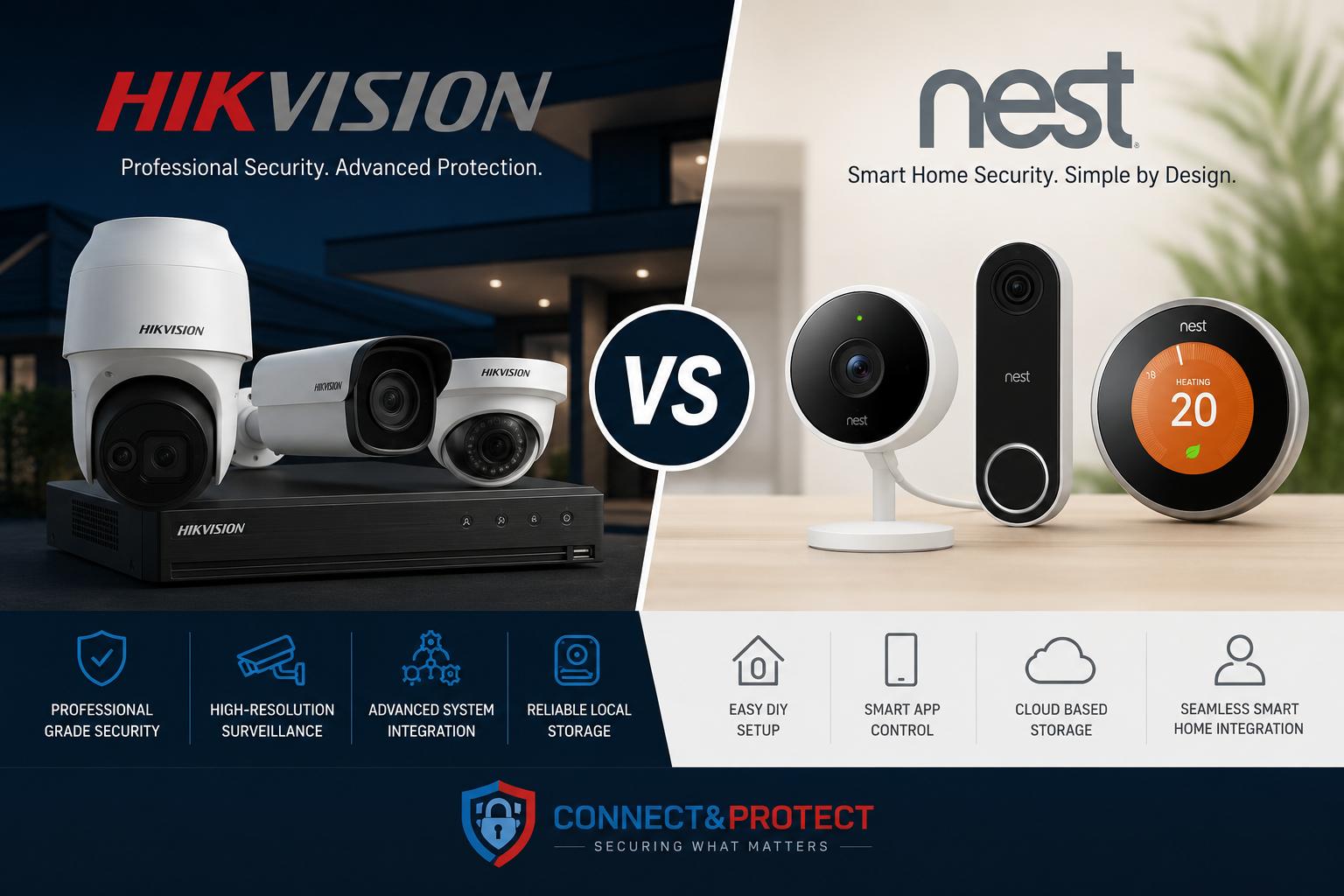
Hikvision vs Nest — securing your home is no small decision, especially with so many options available. Whether you're looking for high-tech surveillance or a simple user-friendly setup, choosing between these two popular brands can feel overwhelming.
Hikvision is a globally recognised leader in security technology, providing advanced, professional-grade surveillance systems. Known for high-quality video resolution, extensive customisation, and robust security features, it's a top choice for those seeking a sophisticated security solution.
Nest, a brand under Google, offers smart, easy-to-use security cameras that integrate seamlessly with other Google products. Designed for homeowners who prioritise convenience and smart home integration, Nest cameras provide AI-powered alerts and cloud-based storage for effortless security management.
|
Hikvision: Professional-Grade Security for Maximum Protection
Hikvision is widely regarded as a leader in security surveillance, with systems used in both residential and commercial settings. It offers high-resolution cameras, AI-powered analytics, and customisable security solutions designed for advanced security needs.
Pros
High-Quality Video Resolution
Hikvision cameras provide exceptional video quality, often featuring 4K resolution and night vision capabilities for clear footage in all conditions.
Advanced Security Features
With AI-powered analytics, motion detection, and facial recognition, Hikvision enhances home security with cutting-edge technology.
Scalability and Customisation
Hikvision systems can be tailored to fit any home size, allowing for multi-camera setups and integration with alarm systems.
Reliable Local Storage Options
Unlike cloud-reliant systems, Hikvision offers local storage solutions — ensuring video access even without an internet connection.
Cons
Complex Installation
Hikvision systems often require professional installation due to their advanced wiring and setup requirements.
Higher Upfront Cost
The initial investment for Hikvision cameras and systems can be expensive, especially for larger homes requiring multiple units.
Not as User-Friendly
Compared to Nest, Hikvision's interface and app can be more complex, requiring some technical knowledge to navigate.
POPULAR: How Much Does a New CCTV System Cost to Install
Nest: Smart Home Integration for Seamless Security
Nest, a brand under Google, focuses on smart, cloud-based security solutions that integrate effortlessly with other Google products. It's designed for homeowners who want an easy-to-use system with AI-powered alerts and remote monitoring.
Pros
Easy Installation
Nest cameras are wireless and simple to set up, making them ideal for DIY installation without professional assistance.
Smart Home Compatibility
As part of the Google ecosystem, Nest integrates seamlessly with Google Assistant, Google Home, and other smart devices.
AI-Powered Alerts
Nest's advanced AI can differentiate between people, animals, and vehicles, reducing false alarms and improving security monitoring.
User-Friendly App
The Nest app provides an intuitive experience, allowing homeowners to monitor their property remotely with real-time notifications.
Cons
Cloud Storage Costs
Nest relies on cloud storage, which requires a paid subscription for extended video history and additional features.
Limited Local Storage
Unlike Hikvision, Nest does not offer extensive local storage, meaning access to video footage depends on an internet connection.
Less Customisation
Nest cameras are pre-configured and do not offer as much flexibility in setup, making them less adaptable for unique security needs.
| Feature | Hikvision | Nest |
|---|---|---|
| Video Quality | 4K, high-resolution | 1080p, good quality but lower than Hikvision |
| Installation | Requires professional installation | DIY-friendly, easy setup |
| Smart Features | AI analytics, facial recognition | AI-powered alerts, Google Assistant integration |
| Storage | Local storage with NVR/DVR options | Cloud-based, requires subscription for full access |
| User-Friendliness | More complex, requires technical knowledge | Intuitive app, easy-to-use interface |
| Cost | Higher upfront cost but no mandatory subscription | Lower upfront cost but ongoing subscription fees |
| Scalability | Highly customisable, suitable for large homes | Limited scalability, designed for smaller setups |
Hikvision vs Nest: Head-to-Head Comparison
Efficiency
Hikvision excels in surveillance efficiency with AI-powered analytics, facial recognition, and high-resolution video recording. Since Hikvision cameras rely on local storage, they continue to record even if the internet goes down — making them highly reliable for round-the-clock security.
Nest focuses on smart cloud-based monitoring, offering AI-driven alerts when motion is detected. However, since it relies on Wi-Fi, its efficiency can be compromised if the network is unstable or there's an internet outage.
Verdict: If you need a high-performance, always-on security system, Hikvision is the better choice. If you prefer a smart, automated system with AI alerts, Nest is the way to go.
Cost
Hikvision requires a higher upfront investment — cameras and professional installation add to the cost. However, once installed, there are no mandatory subscription fees, making it a one-time investment with minimal ongoing costs.
Nest is more budget-friendly upfront but comes with recurring subscription costs. To access full features like extended video history and advanced AI detection, users need a Nest Aware subscription.
Verdict: Hikvision is better for long-term savings, while Nest is ideal for those looking for a lower initial investment.
Durability and Lifespan
Hikvision cameras are designed for professional-grade security — weatherproof, impact-resistant, and built for long-term use. They can withstand harsh conditions, making them ideal for outdoor surveillance in Perth's unpredictable weather.
Nest cameras, while well-built, are primarily designed for indoor and light outdoor use. They are not as rugged as Hikvision cameras and may not last as long in extreme conditions.
Verdict: Hikvision wins in durability and lifespan, making it the better option for outdoor security.
Aesthetics
Hikvision cameras are bulkier and more industrial-looking, designed for professional security. While highly effective, they may not blend well with modern home aesthetics. Nest focuses on sleek, minimalist design — cameras are compact, wireless, and designed to complement modern home interiors.
Verdict: If aesthetics are important, Nest is the clear winner with its modern, stylish look.
Environmental Impact
Hikvision consumes more power due to its advanced hardware and continuous recording capabilities. However, since it relies on local storage, it does not put additional strain on cloud servers. Nest is more energy-efficient with wireless and battery-powered options, though its reliance on cloud storage increases server loads and energy consumption over time.
Verdict: Nest is better for energy efficiency, but Hikvision reduces reliance on energy-intensive cloud servers.
Smart Home Integration
Hikvision is primarily designed for security with limited smart home integration. While some models support third-party apps, it does not seamlessly integrate with voice assistants like Google Assistant or Amazon Alexa. Nest, being a Google product, integrates effortlessly with Google Home and other smart devices.
Verdict: Nest is the better choice for smart home users, while Hikvision is best for standalone security setups.
Installation
Hikvision requires professional installation, involving wiring, NVR setup, and camera positioning. This ensures a high-quality setup but adds to the initial cost. Nest cameras are designed for DIY installation, with wireless setups and user-friendly guides — homeowners can have Nest cameras running in minutes.
Verdict: Nest is easier to install, while Hikvision offers a more robust, professional setup.
Customisation
Hikvision is highly customisable, allowing homeowners to choose from different camera types, storage options, and recording setups. Nest is more plug-and-play, offering limited customisation — ideal for users who prefer simplicity over flexibility.
Verdict: Hikvision is best for homeowners who want a tailored setup, while Nest is great for those who prefer a simple ready-to-use system.
Remote Accessibility
Both brands offer remote monitoring via mobile apps, but their usability differs. Hikvision's app provides extensive control and detailed settings but has a steeper learning curve. Nest's app is more user-friendly, offering real-time notifications and smart alerts with a sleek interface.
Verdict: If you prioritise ease of use, Nest wins. If you want more control and advanced security settings, Hikvision is the better choice.
| Factor | Hikvision | Nest |
|---|---|---|
| Efficiency | Advanced AI analytics, reliable even without internet | AI-powered alerts, dependent on stable internet |
| Cost | Higher upfront, no mandatory subscriptions | Lower upfront but requires ongoing subscription |
| Durability & Lifespan | Weatherproof, built for long-term outdoor use | Good build quality but less durable outdoors |
| Aesthetics | Bulkier, professional-looking | Sleek, modern, blends with home décor |
| Environmental Impact | More power but no cloud server reliance | Energy-efficient but cloud storage increases footprint |
| Smart Home Integration | Limited, better for standalone setups | Seamless Google Home integration |
| Installation | Professional installation required | DIY-friendly wireless installation |
| Customisation | Highly customisable multi-camera setups | Limited, mainly plug-and-play |
| Remote Accessibility | Advanced app control, steeper learning curve | Easy app with real-time alerts |
Which One Fits Your Installation Needs?
Professional Wired Installation: Best for Large Homes & Businesses
If you're looking for a comprehensive wired security system with multiple cameras and continuous recording, Hikvision is the superior choice. Cameras connect to a Network Video Recorder (NVR) for seamless operation.
- Large homes with multiple entry points
- Homeowners who want a high-end, professional security system
- Businesses or properties needing advanced surveillance
- Users who prefer local storage over cloud dependency
Considerations: Installation requires professional assistance and the setup process takes longer compared to plug-and-play options.
DIY Wireless Installation: Best for Renters & Small Homes
For homeowners looking for easy installation without professional help, Nest is the ideal choice. It offers a wireless setup that takes minutes — perfect for renters, small homes, or those who don't want complex wiring.
- Renters who can't install permanent security systems
- Small to medium-sized homes
- People looking for fast and simple setup
- Homeowners who already use Google smart home devices
Considerations: Nest relies on Wi-Fi and cloud storage, so if your internet connection drops, your security footage may be affected.
Outdoor Installation: Weatherproof vs Smart Wireless
Hikvision offers rugged, industrial-grade cameras that withstand harsh weather — the better option for permanent outdoor installations. Nest has outdoor-rated cameras but isn't as robust, and its wireless design means battery life and Wi-Fi stability are factors to consider.
Apartment & Townhouse Installation
For apartment dwellers and townhouse owners, Nest is a better option. Its small, sleek cameras can be placed in key areas without taking up much space, and its wireless nature avoids the need for permanent modifications.
Hybrid Installation: Combining Both for Maximum Security
Some homeowners achieve optimal security by using Hikvision for high-security areas like the perimeter and entry points, and Nest for convenient indoor monitoring. This hybrid approach ensures both professional-grade security and smart home convenience.
Key Takeaways: Making the Right Choice
Hikvision is best for:
- Homeowners who want professional-grade security with high-quality video and advanced surveillance features.
- Those who prefer local storage over cloud reliance for added security and reliability.
- Large homes or businesses needing customisable, multi-camera setups with permanent wired installation.
- People willing to invest a higher upfront cost for long-term reliability without ongoing subscriptions.
Nest is best for:
- Homeowners looking for easy, wireless, DIY-friendly installation that works right out of the box.
- Those who prioritise smart home integration, especially with Google Assistant and other smart devices.
- Renters or apartment owners who need a portable security solution without drilling or professional setup.
- People who prefer AI-powered alerts and cloud-based storage, even if it means paying a monthly subscription.
By understanding the strengths and weaknesses of each system, you can confidently choose the one that best fits your home security needs.
Secure Your Home with Confidence — Choose Connect & Protect
When it comes to protecting your home, making the right choice in security systems is crucial. Whether you're leaning towards the professional-grade reliability of Hikvision or the smart home convenience of Nest, you deserve expert guidance to ensure your security investment meets your needs.
At Connect & Protect, we don't just install security systems — we provide tailored solutions backed by years of industry expertise.
Get in touch with our friendly team at 1300 443 448 or claim your fast and FREE quote online today.
